- Get your ruler. Measure the length & diameter of the nose. Enter the data in Ln and Dn respectively.
- Measure the Length & Diameter of the Body Tube and enter the data next to Lb and Db. Be sure to subtract the fincan length from the Lb! ( That usually means to measure the BT from the end of the nose to the leading edge of a fin. Alternatively, you can leave out the BT and make the whole rocket a Nose and a Fin Can ;-)
- Not implemented in WEB version YET!!
Enter transition data if applicable.
Profiler will accept any number
of transitions, defined by begin tran -- end tran
pairs. Transitions can be entered with the same
front and rear diameter and the data is handled
properly ( i.e. ignored ) for the BEq's. This
feature allows you to enter short sections of MMT
aft of the fins or a Booster Stage Tube or whatever
you can dream up.
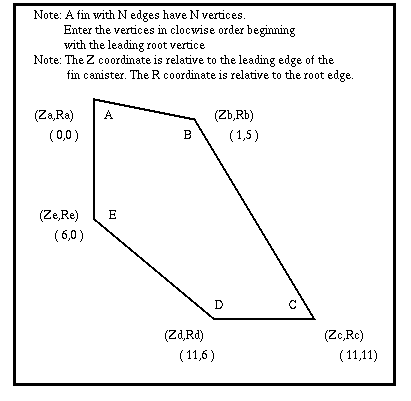
- Enter the fin data. This is the important part.
The fins are
entered as vertices ( which I errantly called edges )
starting at the leading, root and proceding clockwise.
The first value is the Z-val ( distance back along the body tube ) the second val is the purpendicular radial distance ((Z,R) in cylindrical coords ).
Start with the (Leading,Root) point. Enter the (Z,R) val for each vertex. Set the other parameters and you are done.
The Small Print
There is a lot of data ( too much ) in the .dat file. But I am leaving it in there for now because profiler was written as a module for an off-vertical altitude simulator ( overt ).How to Plot a Rocket
PROFILER will produce a .ps plot file for your postscript ready printer and a .dat file which contains numeric data from the calculations. The picture will be marked with some crosses, indicating the centroids and/or CP of various elements. On the Body Tube, one cross ( almost always the 'front' one ) is the centroid of the rocket plan area. The aft one is the CP.
There is also a plot of a disembodied fin(s) that shows the
centroid(s) and the Midchord(s). This is especially useful
for odd-numbered-finned rockets because the fins on the BT
are distorted by the cylindrical to cartesian transformation.
( NOTE: I have not really done any rockets with other than
3 or 4 fins and the algorithm I use won't work on all of
them, depending on the fin shape ).
